Dividers-a Step Off in the Right Direction

dividers_00  Earlier I re-posted a blog entry by George Walker in which he expounded on the once highly important tool known as dividers.  This is a tool that was once so highly valued not a single artisan or scholar would be without it.  Artists, carpenters, masons, joiners, mathematicians and philosophers all felt that they could not perform their chosen profession without a pair of dividers.  So what changed?  Why did this once exalted tool fall out of grace?  I’m not an expert by any means, but here is my opinion, for what its worth.

As the systems of measure became more standardized the need for dividers started to diminish.  High level systems of mathematics were developed and the divider was replaced with abstract numbers.  That’s not necessarily a bad thing.  Differential calculus comes in handy.  The difficulty is that we all but abandoned the practical methods of solving problems.  Before high level, theoretical mathematics, dividers and geometry were utilized to solve all manner of problems.  So every learned individual, on some level, was taught to utilize dividers in a hands-on practical way.

Over time, theoretical mathematics slowly replaced the practical.  Post WWII ushered in the final transformation from practical to theoretical mathematics in the school system.  The Cold War and the space race had every school preparing students to become engineers or at least for advanced college degrees.  That then degraded into “new math” and abstract mathematics being introduced to younger and younger students.  On average a child needs to reach a certain age of development before their brains are capable of abstract thought.  The type of thought need for algebra.  This has led to students simply learning steps to get a solution and not learning why.  Which in turn leaves them with no way to apply the steps in a practical application.

Ok, Ok, I hear you.  Greg! What does this rant have to do with dividers?  Well, with dividers and a straight edge, we common folk can solve complex mathematical problems and only have to know very little if anything about the actual mathematics.  This is real world practical application that we can apply to areas of our lives!

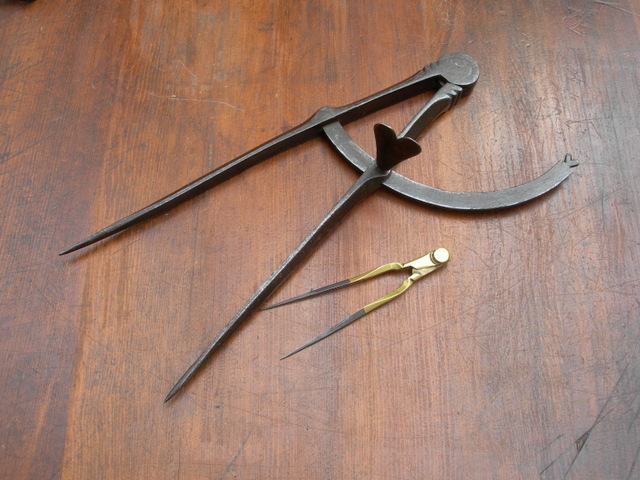
I use the proportional method for designing and laying out of my projects.  Without dividers this method would be all but impossible.  They dictate everything.  I’m also addicted to the tools themselve. “Hello, my name is Greg and I collect dividers.”  I like the wing type most of all.  The better ones have a fine adjustment nut that lets you sneak up on a setting and they have a stout thumb screw lock.  Some are marketed as ‘carpenters dividers’ and have at least one steel point that can be removed and a pencil substituted into it’s place.  This style comes in handy and can do double duty as dividers and as a compass.  It’s good to have a few sets of dividers of varying sizes.  I have a small 3″ leg set and go all the way up to a 12″ leg set.  But a couple pair will be all you will need.  You can always add to your collection later.  Unless you have money to burn, stay away from new.  Second hand is the way to go.  Flea markets, antique stores and Ebay are the places to look.  It’s hard to get burnt when buying dividers.  Simply make sure no parts are missing, the legs are straight and of the same length and will be in good shape.

Dividers are absolute.  You are physically manipulating them.  What you see, is what you get.  Here is an overly simple example but follow me to my point.

Let us suppose that you wish to divide a distance by (5).  So you take a measurement with a tape measure and do the math and get an answer.  Maybe you measured correctly, maybe your math was sound.  Now you take that (1/5) measurement that you calculated and start laying it out across you original length.  Suppose that you are really bold and skip the layout and just cut the (5) parts to fit based on your calculations.  There is lots of room for error in that methodology.  

Now let us work out the problem using dividers.  You set the dividers to you best guess as to what (1/5) should be.  Starting at one end of the original length you step off (5) paces.  You guessed wrong.  You adjust your dividers by approximately (1/5) the error and step off the (5) paces again.  Your really close this time.  One more small adjustment and you step off the (5) paces again.  This time your exact.  Your dividers are now set to exactly (1/5) of the original distance.  You can trust it, you’ve seen it with your own eyes.  You have physically manipulated the dividers within the space.

No math calculation, no room for error.  I don’t know about you, but I’ll take absolute every time.  By eliminating the mathematical calculations and physically manipulating the dividers in your layouts, errors can be greatly reduced.  The process of using dividers results, by default, in your checking for accuracy.  No system is error proof however.  Care must be taken.  My point is that dividers will provide you with a system of layout that reduces the chance of a careless mistake as well as changing the way you think about the physical space of your work.  So buck the system and join me in my crusade for practical mathematics and proportional design.  Step off in the right direction and acquire two or twenty sets of dividers.  (Did I mention I have a problem?)

Greg Merritt

Posted in Design | Tagged , , | 8 Comments

The Most Important Lesson in Woodworking

To date, for me at least.  I know it’s an ambitious title for a blog post, just bear with me.

There are innumerable plans, books, blog posts and videos on building stuff from wood.  Some bad, some good and some are excellent.  They show us what lengths to cut, what joints to cut and how to assemble it all together.  Where the vast majority fall short is at the very beginning.  We are rarely shown the planning and initial full-scale layout.  It’s this full-scale layout that I wish to talk about.

There are articles that talk about story sticks and how they can be used to layout future projects, but very few, if any, that talk about how to create the story stick before the first project is ever built.  That is where the full-scale layout comes into play.  This is a method that I had never used before until recently.  Thanks to “By Hand & Eye” and Paul SellersWoodworking Masterclasses, I’ll never again build a project without first doing a full-scale layout.

Essentially, you draw out full-scale the project that you intend to build.  Usually you just concentrate on the most pertinent view of the project.  That could be a front elevation like say for a bookcase or the end elevation for a table where only the length will vary.  Molding elements are addressed full-scale as well regardless of their locations.  This drawing can be done on a large piece of paper, cardboard or preferably on a sheet of plywood.  From this full-scale layout you can than take all your distances and angles.  Sort of a cheat sheet for woodworking.  This layout will also let you see how your intended project really looks and what space it will truly occupy.  This is handy because you can make any adjustments to size or addition/subtraction of molding elements long before you cut your first piece of wood.  Once you do start cutting wood, you can lay each piece back onto the layout to ensure that you have not made any errors.  Although I’m sure, that like me, you never make errors.  Yeah right!  Once the project is complete you can save the layout for later use or create a story stick.  Even with a story stick I would still create a new full-scale layout before building the project again.

Using a full-scale layout has exponentially changed my woodworking for the better.  What I’m ashamed to admit is that I make my living as a draftsman/designer and it still never occurred to me to make full-scale layouts of my woodworking projects.  Small, scaled down drawings for sure but never full-scale.  Now, I’ll never build another project without doing a full-scale layout first.

Give this method a try on your next project and then decide if my post title is correct.

In my next few posts I’ll discuss some tools that will make these layouts easier.  Some you probably own, some you may have to purchase and some will be part of my “Build Yourself Series”.

Greg Merritt

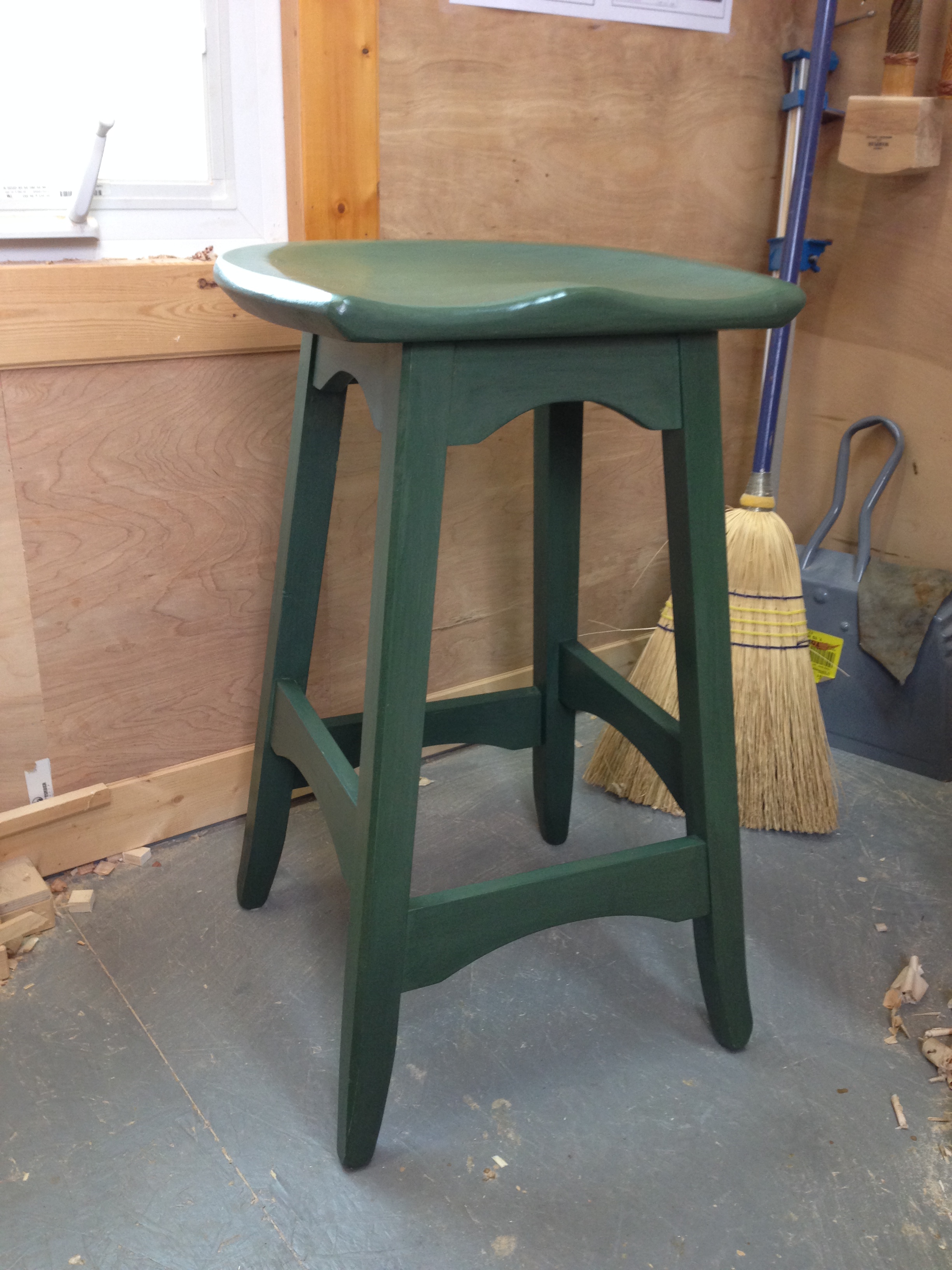
Full Scale Layout of Bench Stool Project

Full-Scale Layout of Bench Stool Project Shows front and side elevations in one view and shows the plan (top) view of the seat.

Completed Bench Stool

Completed Bench Stool

Posted in Design | Tagged , | 8 Comments

Work with Your Hands?

I grew up in an environment where everyone worked with their hands.  My father, uncles and grandfathers could work on everything around the house.  Hell, they built the houses that I grew up in.  My mother, aunts and grandmothers could all sew, crochet, cook can and keep the household running.  We never called on a repair service or contractor for anything.  If something broke we fixed it.  If we didn’t know how to fix it, we figured it out.  Consequently, I learned how to do a lot of things.  Carpentry, electrical, plumbing, appliance repair, there is nothing in or around my home that I cannot repair or maintain.  I can even sew if the need be.  As a child I assumed that this is how it is for everyone.  As I grew older I began to realize that this was just not the case.  It was actually a shock when I started to understand that quite a few people didn’t have what I had always considered basic skills.  Now that I’m even (much) older, I see fewer and fewer people with even a very basic understanding of tools and how to work with their hands.

Because I grew up working with my hands my interests naturally tended toward craft.  More pointedly, how was the craft done and what tools are involved?  Drafting, woodworking, rope work and knots and leather working have always been where my interests lay.  Its the process that fascinates me.  To be able to create something of functional beauty from basic raw materials, what could be more rewarding?  Note that I said functional beauty.  Its very important to me that the things that I create serve a function and are actually put to use.  There are people who are driven to create art for art’s sake.  There is nothing wrong with that and has a place in this world.  It’s just not for me.  I get the most satisfaction, not from the making, but in the seeing of my creations being used.  The more use an item I created shows the more beautiful it becomes.  To my eyes at least.

So it saddens me to come into contact with so many people that have not learned to work with their hands.  They are missing out on the satisfying and rewarding feeling that comes from creating and doing for yourself.  That’s one of the reasons I started this blog.  Hopefully, through the internet, people will stumble onto my blog and find something that will inspire them to work with their hands and create something for themselves.  I also hope that this blog will be useful to those who already work with their hands and help to expand their skills or introduce them to new ones.  If my blog does none of these, then it is a failure.  If it helps just one, then its a success.

Greg Merritt

Posted in Thoughts-Views | 4 Comments

Designer’s Alphabet D is for ……

walkerg's avatarDesign Matters

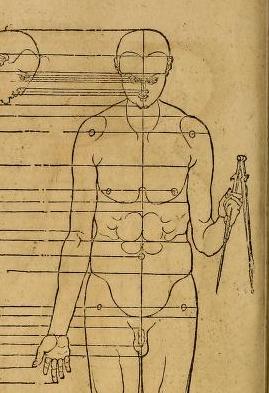
is for dividers, aptly called the tool of the imagination. At it’s simplest it’s a pair of sticks joined at a fulcrum, but this simple tool is one of the most profound of human inventions. Dividers give us the ability to manipulate two imaginary points in space with microscopic precision. They lie at the foundation of everything we know about the natural world. Our curious ancestors used dividers to unlock the proportions in the human form and track the stars and planets as they marched across the night sky.

Proportional study by Albrecht Durer

This ability to plot imaginary points means they have capabilities far beyond mere observation (as if that wasn’t enough). They gave the mariner the ability to navigate the oceans, the builder to design great works of architecture, and to the everyday artisan the tool to create the humble objects that are the stuff of life. Perhaps…

View original post 395 more words

Posted in Design | Leave a comment

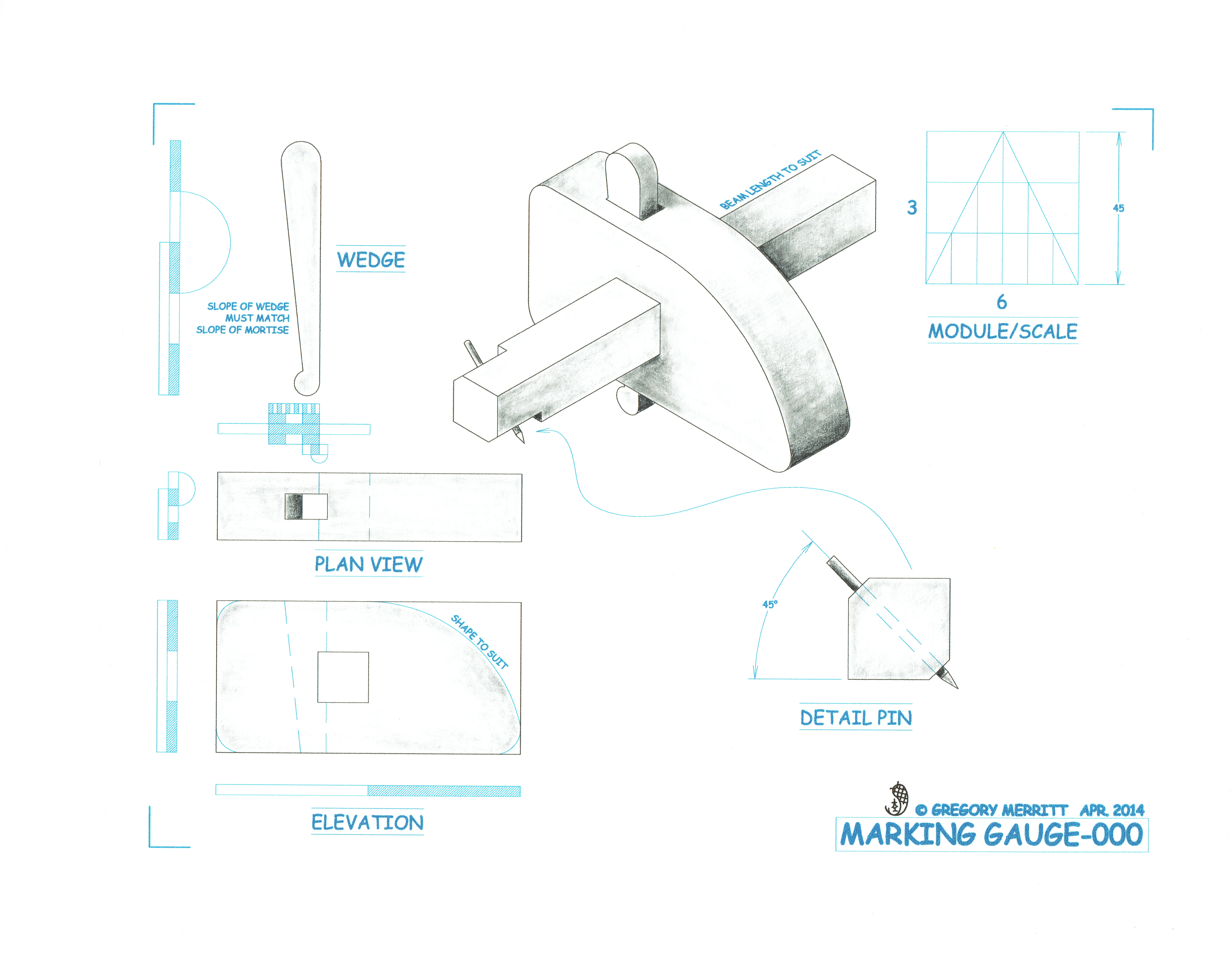
Build Yourself a Marking Gauge

I know, I know, there are a plethora of marking gauges out there to be had.  You can pick one up second hand for just a few dollars or you can spend some serious money on a fancy new model.  I have a few of the former but none of the latter.  From my experience the marking gauges that I’ve purchased have all been lacking in one way or another.  Some were hard to adjust, some wouldn’t hold there adjustments, some had beams that were too loose in their mortises and some worked just fine.

Continue reading

Posted in 5-Tools, Design, Illustrating, Marking Gauge | 6 Comments

“By Hand & Eye”, a Book that Will Change the Way You Look at Everything

BHAE_scan_cover_500_1024x1024From Lost Art Press

By Hand & Eye” is a deep dive into the world of history, architecture and design. And the authors have emerged with armloads of pearls for readers.

Instead of serving up a list of formulas with magical names (i.e. the Golden Section, the Rule of Thirds) that will transform the mundane into perfection, George R. Walker and Jim Tolpin show how much of the world is governed by simple proportions, noting how ratios such as 1:2; 3:5 and 4:5 were ubiquitous in the designs of pre-industrial artisans. And the tool that helps us explore this world, then as now, are dividers.

The key to good design is to master these basic “notes” – much like learning to sing “do, re, mi.” How to do this is the subject of the first three-quarters of the book. It offers exercises, examples and encouragement in opening your inner eye, propping it up with toothpicks and learning the simple geometry that will help you improve your design.

The last quarter of “By Hand & Eye” takes these principles and puts them into practice by designing nine projects that are decidedly contemporary – proof positive that design isn’t reserved for highboys and 18th-century Philadelphia side chairs. The projects show all of the book’s design principles in full flower, and yet the projects are small enough and simple enough (for the most part) that you can use them as a way to explore the book’s concepts without risking a lot of wood or time in the process.

By Hand & Eye” is not, however, a recipe book for better design. The principles of good design are learned through exercise and repetition, and the authors offer the critical exercises in every chapter. Reading about good design is not enough to be able to master it. You have to practice it until it becomes second nature and your hand and your eye work together as one.

This book by George Walker and Jim Tolpin challenged and changed the way I look at everything.  The system of whole number proportions has allowed me stop using measurements, at least imperial and metric, to layout my woodworking projects.  Each piece of a project is now a proportion of the whole and my dividers are what are used to layout lengths and distances.  Once I’ve established a design I can then easily scale the design to fit a particular need or space.  It has been very enlightening as well as liberating.  Even if you are only slightly interested in the process there are geometric constructions and exercises in this book that will make it worth owning.

Greg Merritt

Posted in Books, Design, Thoughts-Views | Tagged , | Leave a comment

Woodworking Masterclasses

I joined Paul Sellers’ online video course Woodworking Masterclasses the day it went live almost a year and a half ago.  Its some of the best money I have ever spent on woodworking.  My skills as a craftsman have increased exponentially.  Joint making, tool maintenance and project design skills have all improved beyond what I thought was possible in such a short time.  Paul concentrates on hand tool methods and building your skills around their use.  His teaching style is methodical and very thorough.  No step in a project is glossed over.  There is a set schedule of a video a week plus there are bonus videos as well.  IMHO this is as close to an apprenticeship that most of us will ever come.

Projects to date have included a wall clock, tool chest, coffee table, bookshelves, bench stool and several others.

So if you are interest in woodworking, especially with hand tools, give Masterclasses a look.  You can create a free account and there are several free videos that you can view to get a feel for what it is all about.  There is also a forum that is populated with like minded individuals who will go out of their way to help.  Paul Sellers’ blog is also well worth adding to your daily reading list.

In the interest of full disclosure I will also let you know that I was recently contracted by Woodworking Masterclasses to provide illustrated drawings for their projects.

07/06/17-Update: I no longer provide illustrations for Masterclasses projects.

Greg Merritt


Posted in Thoughts-Views | Tagged | 4 Comments

Build Yourself a Polissoir

The polissoir, French for polisher, is a simple tool to make and use.  I was first introduced to this finishing tool thru a Chris Schwarz blog entry.  Chris was introduced to the tool  by Don Williams who was working on a translation of Roubo.  A.J. Roubo described its construction and use in his “L’Art du Menuisier”.  There is also a video of Don using the polissoir. Continue reading

Posted in 5-Tools, Finishing, Illustrating, Knot Tying, Polissoir | Tagged , , | 26 Comments