Hillbilly Tansu Handle Rail

Some, not all, but some, of my intended chest designs will require handles for lifting.  I could go the standard route and purchase handles.  Where’s the fun in that?  So I’ll be creating my own, much along the same lines as my knotted pulls.  There are several options when tying handles.  Just about any braid or plait will work.  Also just about any twine or cord will work as well.  The important points to address will be strength and comfort.   Continue reading
Posted in Design, Illustrating, Knot Tying | Tagged , , , , , | 3 Comments

Thicknessing with the Magic Jig

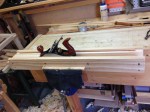
OK, magic may be a little bit over the top, but this thing works great.  The plan for the Hillbilly Tansu designs call for the frame stock to be 36mm square.  The more consistent the pieces are to size, the easier the joinery will go.  Doing this by hand is doable, but fussy.  There is also the chance of ending up under size while trying to get all the pieces to the same thickness.  So I had been struggling to come up with a consistent, and repeatable way to plane all my pieces to the same thickness.  Then, out of the blue, Paul Sellers posted a video on Woodworking Masterclasses that showed the construction of a jig to plane pieces to a consistent thickness.

I adapted the design to work with my intended thickness of 36mm.  After a little trial and error, I had the sizes of the components worked out.  I paid special attention to getting the base board flat and square.  Then I switched my attention to getting the plane runners to a height that would produce my intended piece thickness.  The fussy part here is to account for the drop that will result in the blade removing wood from the runners until the edges of the plane body bottoms out on the runners.  Once you reach this point the blade won’t remove anymore material from the runners.  Unless of course you increase the depth of cut.  So I did quite a bit of practice runs until I had the result I was after.  Then it was just a matter of securing all the remaining loose bits and pieces.

One thing to note is that this jig will thickness a piece, but will not square the sides to each other.  Since my pieces will be square in shape, its important that I have all four sides of the oversized piece square to each other.  Once I have that, it’s just a matter of dropping the piece into the jig, watch the grain orientation, and plane away.  Flip the piece before you bottom out and finish planing to thickness.  Then do the same with the other two sides.  Just like magic, I have a square piece that measures 36mm on each side, every time.

Greg Merritt

Posted in 5-Tools | Tagged , , | 12 Comments

Hillbilly Tansu Marking Gauge

While working through the design elements of the Hillbilly Tansu I paid particular attention to how the joinery was laid out.  The last thing I wanted to do was create something that would require multiple gauges and several different tool setups.  What I ended up with is actually quite simple.  All of the plowed grooves are the same width, depth and distance from the face edge of the pieces.  So one setting of the plow plane handles all.   Continue reading

Posted in Design, Hillbilly Tansu Joinery | Tagged , , , | 5 Comments

Hillbilly Tansu Side Bearer

So I’ve shown the front and rear bearers now I ‘ll show how I plan to connect the two.  The joinery is really very simple.  A full length groove and two stub tenons.  These pieces will complete the enclosure of the dust and floor panels.  They will also be the bearing surface for the drawers.  In this instance a guide block will need to be fitted and glued into place to keep the drawers from drifting side to side during operation. Continue reading

Posted in Design, Hillbilly Tansu Joinery | Tagged , , , | Leave a comment

Hillbilly Tansu Rear Bearer

Directly opposite of the front bearer in the Hillbilly Tansu is, you guessed it, the rear bearer.  This element of the assembly will tie the two rear posts together and provide attachment points for the side bearers and the dust panels/floor.  Nothing ground breaking in this joinery.  It’ just a slight variation of the front bearer joinery. Continue reading

Posted in Design, Hillbilly Tansu Joinery | Tagged , , , | 1 Comment

Back on the Grid and a Carcass Laid Bare

hb_carc_2The power company has me reconnected to the grid.  It’s amazing how dependent I am on electricity.  It’s a little scary, actually.  But that is the life we live now.  Anyway, glad to have the electrons flowing again.

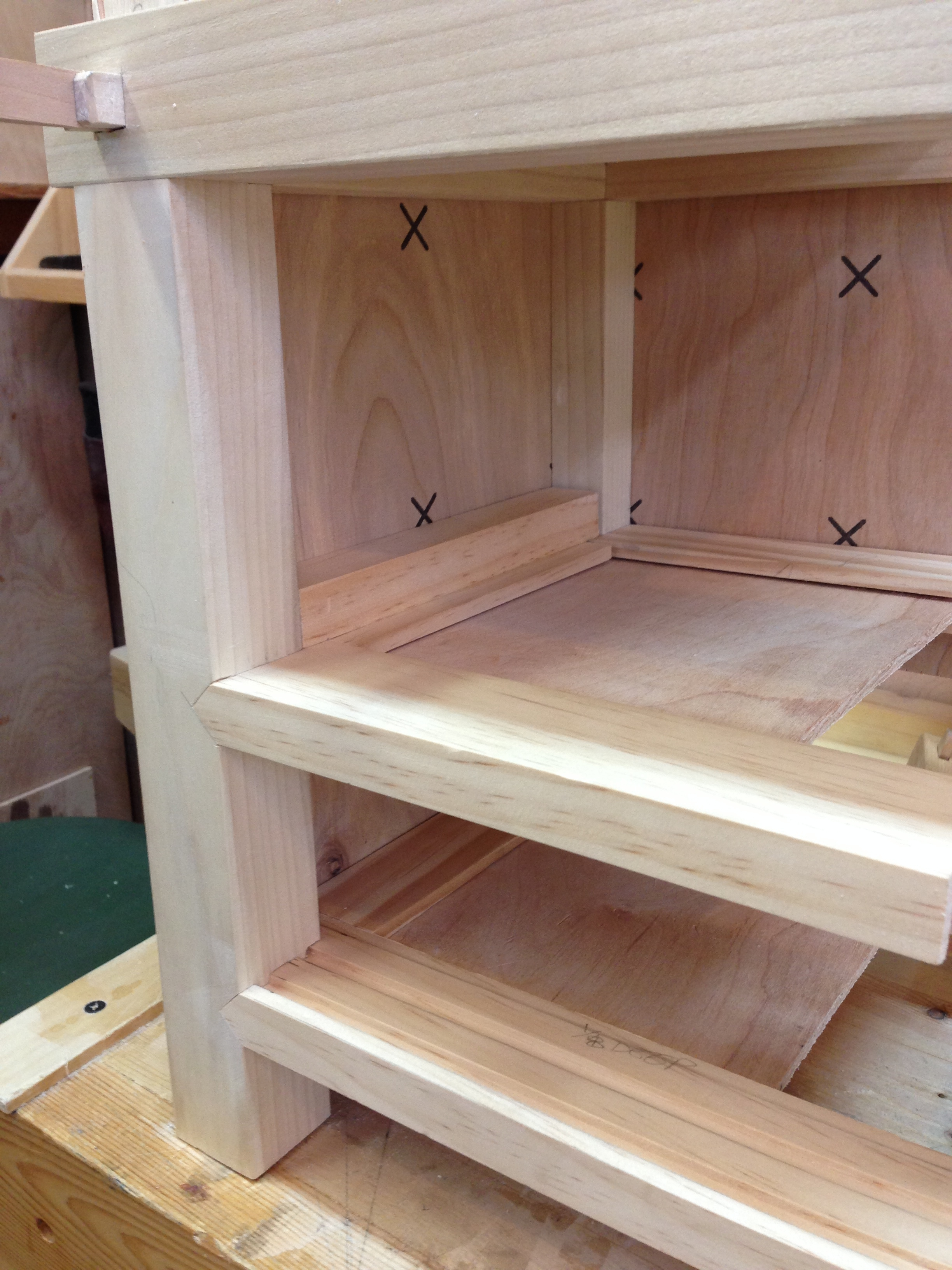
I thought I would post a little update on the Hillbilly Tansu project.  I believe that I have all of the construction details worked out.  The photo shows the carcass mockup with samples of the major components.  The mockup has luan plywood panels to show the idea.  The actual build will use high quality birch plywood for the outer panels, dust panels and drawer bottoms.  I know some of turn your noses up at the use of plywood but here is my reasoning.  hb_carc_1Quality ply can be finish planed, it’s dead stable and stronger than solid wood.  What’s not to like?  While researching antique tansu, almost all of the images revealed the same problem.  Split panels.  So I’m using plywood, the good stuff, not the crap in the photo.  Feel free to denigrate me for it, but my panels will remain solid.

For those of you who may be playing along, I’ll be posting drawings and details on the remaining construction elements as I get the drawings completed.

Greg Merritt

Posted in Design | Tagged , , , | 8 Comments

Offline for a Few Days

We had a fairly robust storm roll through my neck of the woods yesterday afternoon.  It took out trees and power lines with reckless regard.  As a result several thousand people in my area are without power, myself included, and will remain without until at least Friday.  So if I do not respond to comments and/or questions I’m not being rude I’m just off grid.  My access to the internet will be sporadic at best, lunch hour and after work hours before I head home.  I was lucky, no damage at the homestead, but several of my neighbors sustained damage to their homes.  I have several hours of picking up limbs and debris, but that is all.  It could have been much worse.  Anyway, I’m heading home to try my hand at running a generator.

Greg Merritt

Posted in Thoughts-Views | 8 Comments

What a Mess!

shop_mess

I have a bad habit of not cleaning the shop while I’m working on a large project.  I could make all sorts of excuses for my behavior, but I really need to do better.  Thankfully the weather this weekend was a little cooler and the end tables are done, so I was able to tackle the mess in the shop.  While I was at it, I took the opportunity to reorganize a few things so that work flow will, hopefully, be a little better.

shop_cleanI built my small shop a few years ago so that I would have a place to tinker.  When I had it finished I just moved my tools in with no plan on how I was going to use the space.  Hell, I didn’t even have a workbench.  So I floundered around in the space for a while until I stumbled on Paul Sellers’ website.  Soon after, I bought his book and built my workbench from the plan that is in the book.  Then came Woodworking Masterclasses and I began to add tools and develop some work habits.  So the shop space had sort of evolved along with my skills.  I’ve been changing things around to accommodate the work flow as I went and took this opportunity to finalize those changes.

I have never been one to keep things stagnate.  So I’m sure there will be additional changes as time passes.  Anyway, the shop is clean-ish and ready for the next project to start.

Greg Merritt

Posted in 8-Miscellaneous | Tagged , | 5 Comments

It’s the Last Things

It’s always the little things that make the difference.  One last pass with the plane can turn an OK surface into a pristine one.  One last thin shaving can make a tight tenon fit perfectly.  In this instance its one last coat of tinted wax.  I know, I know, I said no more posts about the end tables but the difference that the tinted wax made warrants one last post.

I made a quick run to Woodcraft and bought some dark brown Briwax.  Brought it home and applied one last coat of wax to the tables.  I knew in my mind that the tinted wax would even out and enhance the finish but the difference is dramatic enough that I thought it warranted one last show and tell.


Barn Red Milk Paint with shellac and wax

That’s it for these tables…I swear.

Part 13 Greg Merritt

Posted in End Tables, Finishing | Tagged , | 12 Comments

End Tables Part 13 – Done!


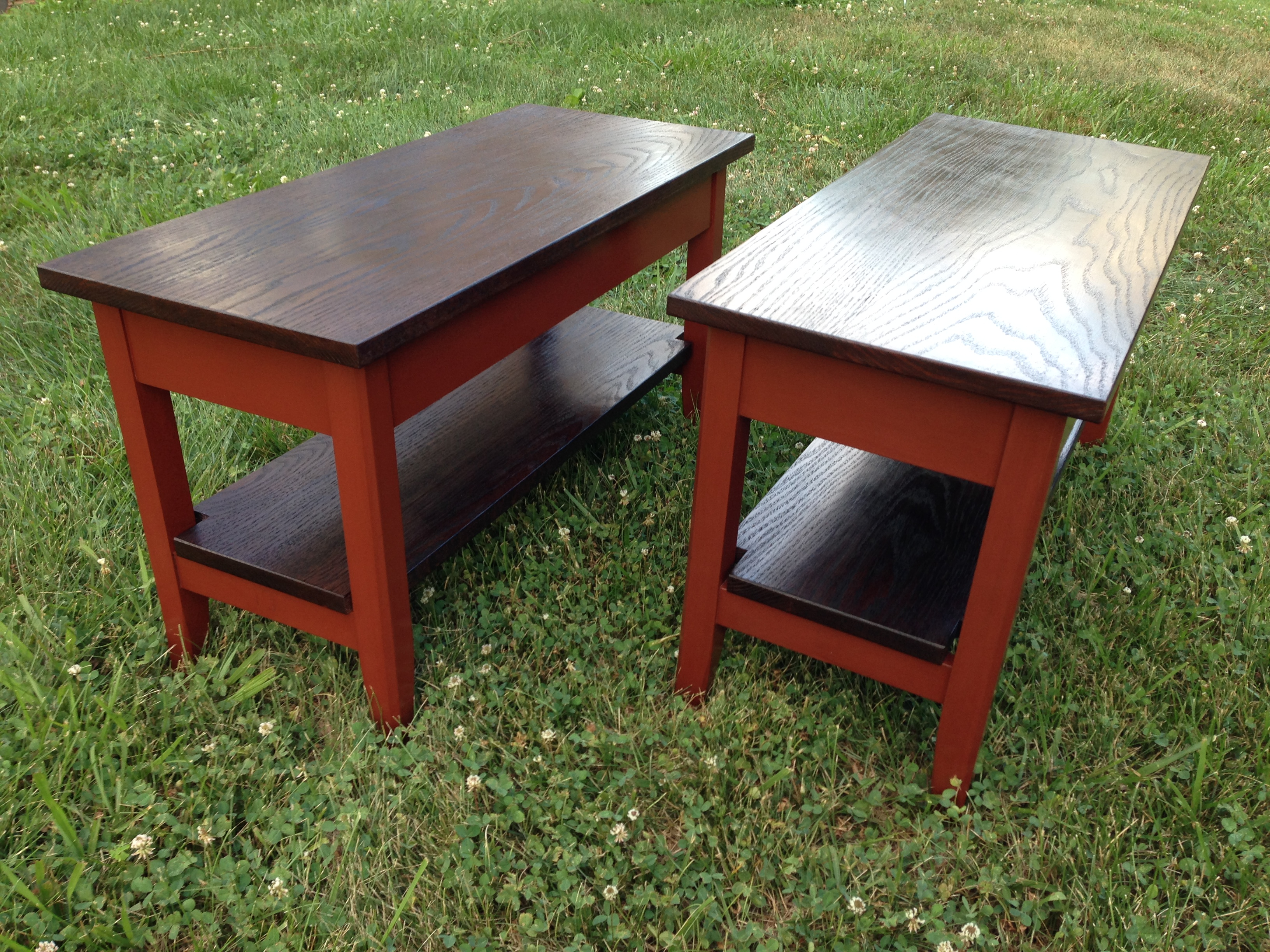
Whew!  These tables are now moved into the done column.  This has been a long and drawn out build for me and taxed the confines of my small shop.  I actually had to move the bases into the house so that I would have enough room to work on the tops and shelves.  Summer caught up with me too and the heat and humidity did very little to speed up the completion of these tables.  The only task left to do is apply a coat of tinted wax the tops and shelves.  The clear paste wax that gets caught in the open grain of the oak dries an unsightly white, so tinted wax should cure that little issue.

These tables only required some basic shaping skills and the use of mortise and tenon joinery.  Nothing fancy, nothing difficult.  So anyone can tackle this type of project and I hope that you will be encouraged to do so if building a table is something you have not tried yet.  These tables are a variation on a project that was presented on Paul Sellers’ Masterclasses series.  I can highly recommend the series.  It is very thorough in covering the construction process from start to finish.

Did I use exotic lumber? Nope.  I used wood that can be had at the big box store.  The legs are poplar, the rails are pine and the tops and shelves are red oak.  Will these tables be recorded in the annals of fine furniture?  Nope, but they are solid, well-built tables that will easily last my lifetime and hopefully a couple of generations beyond that.

The finish on these tables took almost as long as building them.  Of course that is expected.  The base assemblies received a coat of barn red milk paint which was then burnished smooth with 0000 steel wool.  That was followed by a few coats of clear shellac which was also buffed out with steel wool.  Finally the bases were given a couple of coats of clear paste wax and buffed with a soft cloth.  The tops and shelves revived a coat of dark brown Transtint dye.  Then they were burnished with the polissoir and bees wax.  This was my first large project utilizing the polissoir and I’m really happy with the results.  The tops and shelves are very smooth with an even sheen.  If not for the open grain of red oak the tops and shelves would be glass smooth from the polissoir.  I was afraid that the polissoir would be time consuming, given the size of the panels, but the whole process went fairly quick.  I’ll be using this finishing method again without a doubt.

I can look at these tables and find every blemish or slight error.  Things that no one else will see even if I point them out.  I think this is common with those of us who build things. After a week or two of use they will once again be perfect in my eyes and I will be completely engrossed in the next project.

So that should do it for the saga of the end tables.  Thanks for following along and I hope you enjoyed it.

Part 12 Greg Merritt Extra

Posted in Design, End Tables, Finishing | Tagged , , , , , , , | 6 Comments