Boxing Up the Scrap Pile

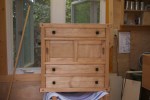
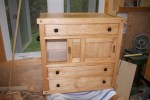
The HB Tansu project that I just finished, made good use of the lumber that I purchased.  I designed it so that it would generate a minimum of scrap based on what is available at the Big Box stores.  Even so there is a certain amount of inevitable scrap.  Of course, in reality, I don’t consider any piece of wood as scrap.  Consequently my pile of pieces has grown to be far too large.  I decided that before I begin another tansu I would make as many things from the scrap pile that I possible could.

box-3I spent most of the week getting my tools in back in order.  Everything was sharpened and oiled.  All the planes were dismantled, cleaned and oiled.  The shop floor didn’t get swept but I’ll get to it….eventually.  I then turned my attention to the scrap pile taking stock of what I had available to work with.  I then spent a couple of evenings sketching out some ideas, but nothing was working for me.  Saturday morning I decided to just wing it.

box-2I started with a chisel box.  I recently bought a few new chisels and needed something to put them in.  I need to write a post about these chisels but I want to use them for at least another large project before I can really tell you anything definitive about them.  To arrive at the size for the storage box I laid the chisels on the bench and made a tick mark on my wood for the length and the width.  The joinery I used for this box was based on a photo that I had seen of an antique Japanese box.  The joints are just finger joints that change orientation at the each corner and are then pinned.  The joinery works but it’s a hassle to hold everything together during assembly.  I won’t be using this joinery again in the future.  The box is strong but way too much work to wrestle all the pieces together.  I added a groove to three sides to receive a sliding lid.  The lid will make use of some of the left over birch ply.  The interior was just a matter of accommodating the chisels.  I added a keeper over the blades so that I can stand or lean the box at the end of the bench while I’m working and the chisels won’t fall out.  To retrieve a chisel I just have to lift, tilt and slide the chisel from its slot.  I almost have this chisel box done.  There is some cleanup on the lid and I want to add some decoration to the lid as well.
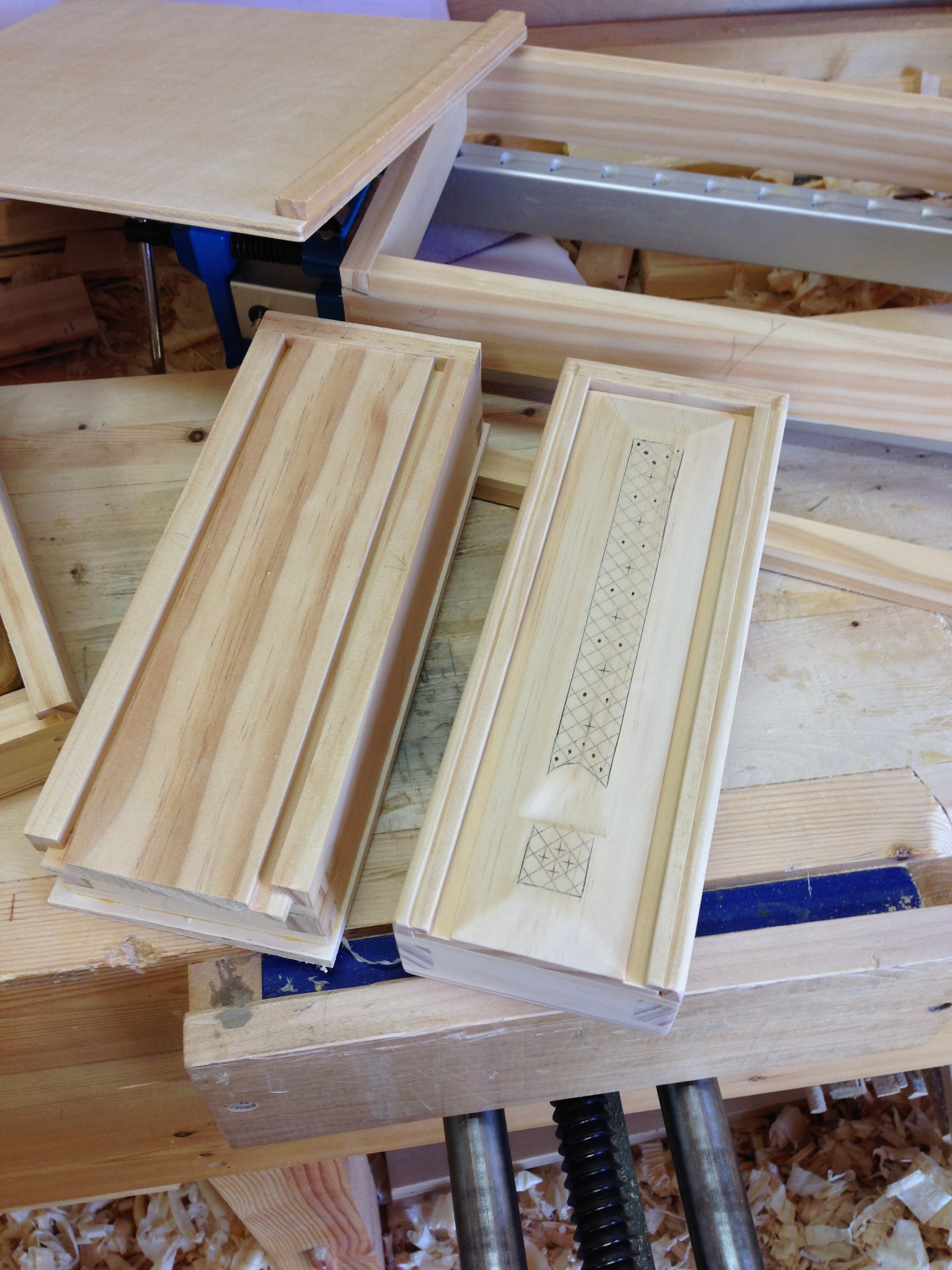
box-1The rest of the stock that I had available was long, but fairly narrow in width.  Most of the pieces were around 2″ or less.  These pieces were just about right for making pencil boxes. So that is what I did.  The design is based on one presented by Paul Sellers in his Masterclasses series.  I modified it to suit my stock though.  These boxes are dovetailed together and have a sliding lid.  The lid is shaped as a raised panel and I added some hillbilly inlay (kolrosing) for decoration.  I managed to have enough stock for two pencil boxes.  One is slightly shorter than the other, but still plenty long enough to serve its purpose.  The decorated one is ready for shellac and the other still needs a bit of work.

The remaining pieces were too narrow for pencil boxes and I settled on a storage tray.  This one will live beside my chair in the living room and hold the odds and ends that I always seem to have piled up on the side table.  This tray is assembled with a single dovetail at each corner and will have a birch ply bottom.  The frame is in the clamps and I’ll get a bottom on it tomorrow evening.

I have no idea of any of the sizes for these boxes.  The chisel box is big enough to hold my chisels.  The pencil boxes are long enough to hold pencils and the tray is sized to my largest piece of remaining birch plywood.  There is something liberating about making something useful with no plan and no measurements.  I’ll complete these boxes this week and apply a finish to them.  That will put a couple of pencil boxes in the gift pile for Christmas and the scrap pile is a little smaller.

Greg Merritt

Posted in 8-Miscellaneous | Tagged , | 8 Comments

Meat Powered Bamboo Peg Cutting Machine

The Hillbilly Daiku proudly presents:

The Meat Powered Bamboo Peg Cutting Machine 

While researching tansu I noted that the drawers where typically pegged together.  I little further research turned up a couple of videos, here and here, that showed these pegs being installed.  After a good bit of poking around on the internet I managed to find a couple of suppliers.  One is in Germany and the other is in Australia.  I could order them but the cost of shipping is just too much to make it worth it.  I’m also trying to keep the materials list down to readily available materials.  So on to other options. Continue reading

Posted in Design, Hillbilly Tansu Joinery | Tagged , , | 7 Comments

Bench Upgrade and Maintenance

My shop time was limited this weekend.  There was grass to mow and several other household related things that needed doing.  Since I just completed a fairly large project, I’ve been making notes.  Some have to do with the construction of the HB Tansu and some are shop and tool notes.  What works, what doesn’t and what would make the process go a little smoother.

Two of these notes concerned my workbench.  I like my workbench.  It’s Paul Sellers’ design from his book, “Working Wood 1&2“.  It is my first “real” bench so I have nothing to compare it too, but I have not found it lacking, except.  From the outset, I’ve found that I wanted or needed a stop at the end of the bench.  Paul does almost everything in the vise and it obviously works for him.  I find that I don’t like working in the vise all the time.  Several operations I can complete quicker on the bench top with the workpiece butted up against a stop.  My solution, for well over a year now, was to simply screw a 1/4″ piece of scrap to the bench top.  This has worked well but gets in the way at times.  Then I have to unscrew and remove it.  Then reinstall again when I need it again.  Time for an upgrade.

09-07-14-03

Below the bench top and still clears the drawer.

I purchased a couple of 5/16″ lag studs plus washers and wing nuts.  I already had an off cut of 3/4″ birch ply set aside to use as a fence/stop.  The job was simple.  Cut two vertical slots in the plywood fence and install the lag studs in the end of the bench.  The slots were done by drilling two holes, saw out the waste between them and cleanup with a rasp. Now I have a stop that sits below the bench top when not needed and can be raised to any height, up to an inch, when required.  It’s very solid.  Done.


The other note concerned the chewed up edge of my bench top.  I do the vast majority of my sawing in the vise.  Cross cuts and rip cuts.  As a consequence the edge of my bench top gets a little ragged from the saw.  I didn’t worry about it too much, its ugly, but nothing else.  Lately though I’ve picked up a few splinters from this ragged area.  At first I thought that I would just smooth it up with a chisel and sandpaper, then Paul Sellers posted about how he had recently addressed the issue.  So I followed his example and inset a sacrificial piece.  Of course I already scarred it up, but it looks and feels much better.  Done.

This week I’ll be giving some TLC to all of my tools.  Planes will be dismantled, cleaned and oiled.  Blades, cutters, saws and chisels will be sharpened.  The shop will get a good cleaning up as well.  By next weekend I should be ready for the next project.

Greg Merritt

Posted in 5-Tools | 11 Comments

Solutions Present when You Least Expect

I just completed the first Hillbilly Tansu and I’ve been evaluating all aspects of the project.  In truth I’m picking my work apart.  Those of us who create or build things tend to be most critical of our own work.  We see every flaw, no matter how minor.  We see these flaws because we know we made the error.  We have to be careful though.  This critical evaluation of our own work can drive some folks over the edge.   Continue reading

Posted in Design, Knot Tying | 3 Comments

HB Tansu Progress-12-Completed

Hear ye, hear ye, hear ye.  On this, the 31st day in the year 2014, the first iteration of the Hillbilly Tansu has been completed.  🙂

I started with an idea born from my admiration of the Japanese frame and panel tansu.  After hours of searching and coming up empty as to how these tansu are constructed, I elected to develop my own joinery for constructing a cabinet that mimicked the Japanese form.  From there the project became a quest for developing an entire system of construction.  This led me to developing joinery, framing elements and even jigs and tools to facilitate the construction of what I have dubbed the Hillbilly Tansu.  Overall I think my efforts have been fruitful.

The construction methods and joinery that I developed all worked out very well.  There were some silly mistakes on my part as to the execution, but the methodology is sound.  This system allowed for very quick build process.  The key to this, IMHO, is that the construction is modular.  Each module, front frame,  rear frame, drawers and doors, is a simple and easy to handle assembly.  With the exception of some dependent layout elements, each module can be fabricated independently of the other.  I found this much easier to manage in my small workspace.

Another item of consideration was material.  I wanted to be able to build this project from readily available material.  For me this means lumber from the big box stores.  I opted to purchase my birch ply from Woodcraft due to the poor quality of the plywood available at my local big box store however.  The difference in the plywood is not something that would have been critical though.  All the other lumber was purchased from the local Home Depot.  I actually designed the framing elements so that they could be constructed from 2x construction lumber.  As luck would have it, my local Home Depot carries 1.5in square x 8ft lengths of clear pine.  So that is what I used to build this first HB Tansu.  Another option for the framing lumber is to purchase turning squares.  These can be mail-ordered in 1.5in squares x 36in long and are available in several different species.  At a price of course.

I like to fabricate my own hardware when possible.  For this project I did just that.  I employed my knot tying skills and fabricated the drawer pulls and the lifting handles.  Both of these were tied using tarred nylon twine.  This type of twine is strong but also gives the impression of iron hardware.  The sliding door pulls were carved into the door frames themselves.  I added some incised crosshatching to provide an element of texture and to increase the color value to better blend with the other hardware.  I’m not totally sold on this method and will be trying to come up with something else in the future.

The finish was an experiment that I do not recommend.  Unless you want to develop a complex concerning your surface preparation abilities.  The idea was to use two tinted waxes and burnish them in with the polissoir.   Pine and birch are notoriously temperamental when it comes to dyes and stains and I should have known better.  My thinking was that the tinted wax would offer a bit of control in uptake of the color.  It didn’t!  In the end I was able to use a final application of clear wax, applied with steel wool, to blend the colors as best I could.  This lightened the color as well.  I’m not thrilled with it, but it’s not too bad.

This first HB Tansu was built as a proof-of-concept and overall I’m happy with the results. The design lends itself to being scaled and there are almost endless possibilities as to configuration.  I’ll be building one more of this configuration just to verify my initial findings and to try another finishing technique.  I’ll be sticking with clear shellac and wax on the next run.

Thanks for following along.

Greg Merritt

Posted in Hillbilly Tansu-000 | Tagged | 10 Comments

HB Tansu Progress-11

By all rights I should have been able to complete this project today.  However, the heat and humidity ran me out of the shop around mid-day.Tomorrow is supposed to be cooler and I should be able to apply the finishing touches  to this first HB Tansu.

What I was able to accomplish, before the heat went above 90deg, was to complete the construction of the sliding doors.   Continue reading

Posted in Hillbilly Tansu-000 | Tagged , , | 2 Comments

HB Tansu Progress-10

I took a day of vacation today so that I could squeeze out a four-day weekend with Monday’s holiday.  Today’s plans included only two things.  Install the handles and build the sliding doors for the HB Tansu.  Simple and easy….not so much.

I have been working on the handles over the past several evening and finally finished Continue reading

Posted in Hillbilly Tansu-000 | Tagged , , , | 4 Comments

HB Tansu Progress-9

All the drawers are fitted, the bead detail is applied, have an initial coat of finish and the knotted pulls are installed.  Not much to report as to the process.  Just more of the same that was involved in drawer no.1.  One thing that I did do was to apply bee’s wax and burnished it in on all of the runners and drawer sides with the polissoir.  The drawers are running nice and smooth.  They have that satisfying puff of air escaping when they are shut. Continue reading

Posted in Hillbilly Tansu-000 | Tagged , , | 7 Comments

My Thoughts on Liquid Hide Glue

When I designed the Hillbilly Tansu, I made a concerted effort to make it modular.  Even so, it became apparent that glue-ups would be challenging.  Lots of joints needed to be seated with each stage of construction.  Experience tells me that the ubiquitous yellow wood glue requires speed in these types of glue-ups.  If you’ve ever experienced joint “freeze” in the middle of an assembly, you know what I’m talking about.  I actually considered going the traditional Japanese route and use rice glue.  It’s easy to make but needs to be made before every gluing session.  That’s not going to happen in my shop.  There is no way I could plan my limited time in the shop to include cooking rice and mashing it into paste.  So a little bit of research and the overwhelming solution seamed to be liquid hide glue.

I’ve read about, watched videos but never used hot hide glue.  Animal bits soaked and cooked in a double boiler creating, by all accounts distinctive smelling, amber glue.  But this stuff sets up quicker than our friend yellow glue.  In fact, that is one of the advantages of hot hide glue.  It’s highly recommended for operations where you want the parts to stick together as quickly as possible.  Panel assemblies and veneer work top this list of applications for hot hide glue.  I knew liquid hide glue existed but never gave it much thought.  I was generally happy with the yellow glue that I had been using and I wrongly assumed that the liquid version behaved just as the hot version.  Not so.

Liquid hide glue is, in fact, hot hid glue but with the addition of urea.  The added urea causes the glue to remain liquid at room temperature or slightly higher.  The other thing that the urea does is retard the set time.  Now the setup and cure is determined by evaporation or absorption of the glues water content resulting in a longer working/open time.  Inside the joint the wood absorbs the water.  Any squeeze out relies on evaporation.  This means that any thicker globs of squeeze out could take days to dry.  So you will want to address any squeeze out during the assembly.

There are two options that are available for purchase on the market.  Titbond and Old Brown Glue.  Essentially these two are the same.  The main differences being that the Titebond version is liquid at room temperature and widely available and Old Brown Glue needs to heated above 140deg to obtain a liquid state and may be more difficult to locate, although this seems to be changing.  Strength and open time for the two are almost identical.  Popular Woodworking did a side-by-side comparison of the two and detailed the results.  You can read that article here.  An additional feature of liquid hide glue to note is that it is reversible by applying heat and water.  If you make an error during assembly, you have the option of taking it back apart.  Years down the road if something is damaged, you can disassemble, make repairs and then glue the assembly back together.  Which brings up a disadvantage.  High moisture and heat areas are not good locations for items that are assembled with hide glue.  Bathrooms, kitchens and anything out-of-doors.  The liquid hide glue from both manufacturers has a shelf life.  So be sure to check the date on the container before you purchase.

hide-glue-suppliesMy local Woodcraft carries both brands of liquid hide glue and in the end I chose to go with the Titebond product.  I made this decision solely on the fact that it is ready straight out of the bottle at room temperature.  I didn’t want the added complication of having to heat the Old Brown Glue before using it.  I also picked up a couple other items to make my glue-up go a little smoother.  Up to this point I have always used yellow glue straight from the bottle.  Squeeze out a dollop on the joint and distribute the glue with a scrap of wood that was roughly shaped for the task.  I decided that a little more sophistication was in order and purchased a silicon glue tray and a package of glue brushes.  Woodcraft actually sells two different glue trays.  One touted for brushes the other for rollers.  The one for brushes seemed too deep and the sides too flexible, so I opted for the one designed for glue rollers.  Works great.  The glue stays in a puddle at the bottom and the brush lies on the ramp.  Wet glue washes off easily and dried glue will just peel free from the silicone.   The brushes are sold as disposable but, since hide glue will dissolve in water, I just give them a soak and a rinse and they are ready to go again.

I wish that I had tried liquid hide glue before now.  The extended working time has greatly reduced my stress level during glue-ups.  Plus there is the added comfort of knowing that I can take something back apart in the event of a major malfunction.  I find it much easier to control the application of liquid hide glue as opposed to yellow glue.  The liquid hide glue has a thicker consistency and stays where I put it.  No runs or drips.  Clean up is easy as well.  I have yet to experience any joint freeze while using the liquid hid glue.  Even on my most time-consuming assembly that ran at least 30 minutes.  In fact, I feel that the liquid hide glue adds a measure of lubrication.  Joints go together easier than when they were dry and gentle clamp pressure is all that is needed to fully seat them.

Will liquid hide glue completely replace yellow glue in my shop?  Probably not, but yellow glue will see limited use from now on.  I’m completely satisfied with the Titebod liquid hide glue, but may give the Old Brown Glue version a try when I need to replenish my supplies.  If for no other reason than to support a small American company.

Here are links to other articles that discuss liquid hide glue: Chris Schwarz , Paul Sellers

Greg Merritt


Posted in Hide Glue, Thoughts-Views | Tagged , | 16 Comments

HB Tansu Progress-8

I wasn’t completely satisfied with the joinery at the rear of my first drawer.  I spent most of Friday evening trying to come up with a better layout.  I also wanted to make assembling the drawer easier.  The pegging system caused issues with the clamping.  With the first drawer I had to wait for the glue to set then remove the clamps so that I could add the pegs.  I wanted the pegs to eliminate the need for clamps.  So this first setup was the wrong way around. Continue reading

Posted in Hillbilly Tansu-000 | Tagged , , , | 4 Comments